
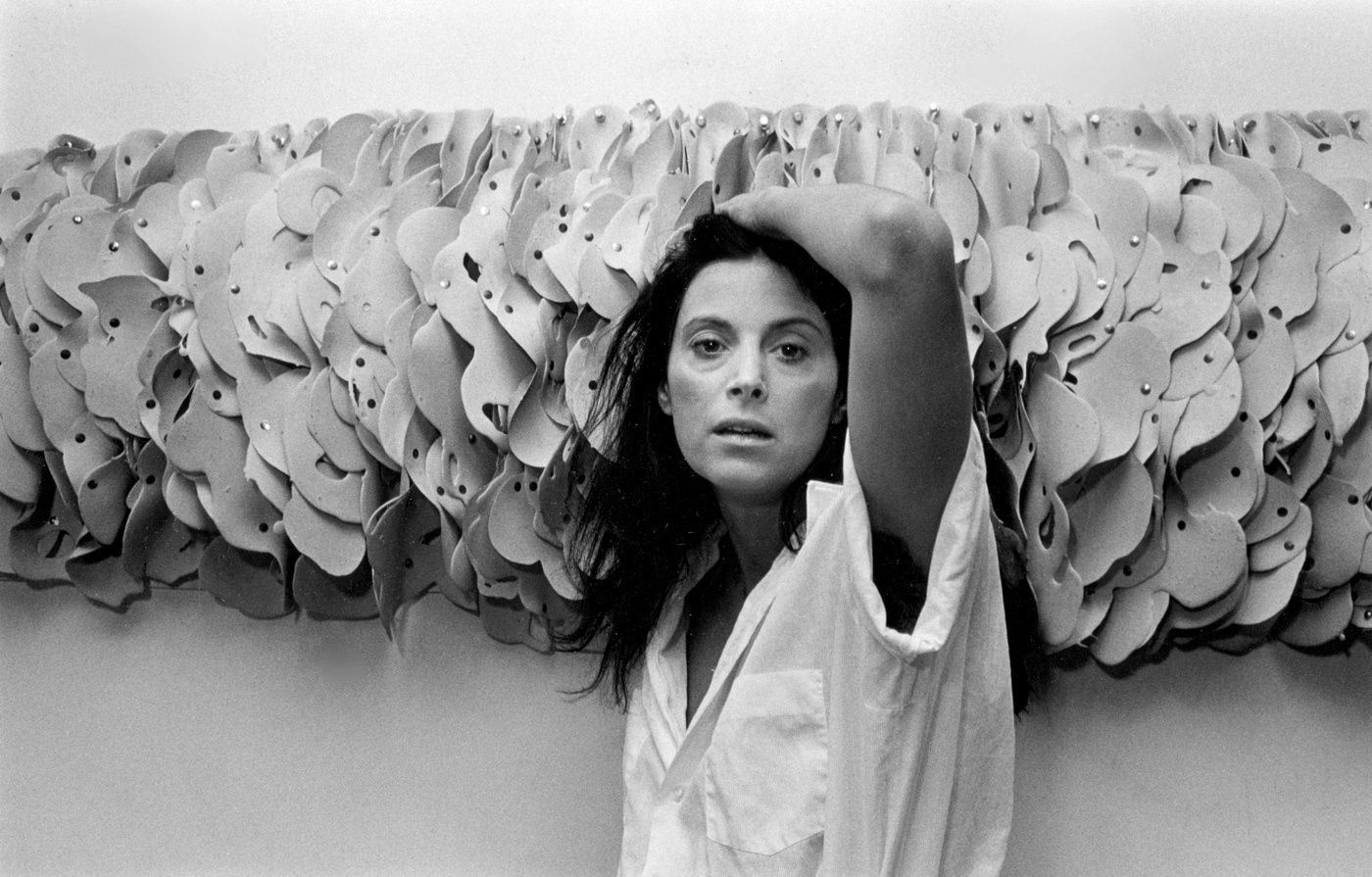
A pioneer in video and performance art, Hannah Wilke frequently used her own body—often nude or partially nude—as a central element in her work, challenging conventional ideas about femininity, sexuality, and the body. Her mother’s battle with cancer, followed by her own diagnosis, profoundly altered the course of her work, introducing a deeply personal and unsettling dimension to her artistic practice. Wilke died in 1993 at the age of 52.
Intra-Venus was Hannah Wilke’s final body of work. It was first exhibited posthumously in 1994 at the Ronald Feldman Gallery and consists largely of images made in collaboration with her husband, Donald Goddard. The series focuses primarily on Wilke herself, with the photographs most often presented as diptychs, and occasionally as sequences of three or four images arranged in rows or grids. The project also includes a video component, filmed by Wilke, Goddard, and others. The Intra-Venus Tapes contain more than 30 hours of footage, presented simultaneously across 16 monitors and documenting friends, family, medical procedures, and even birds. Although the footage was recorded between 1990 and 1993, it was not exhibited until 2007.
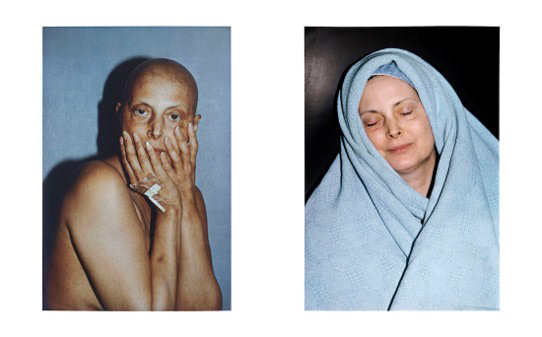
Hannah Wilke, “Intra-Venus Series #4, July 26 and February 19, 1992, Performalist Self-Portrait with Donald Goddard.” Two Chromogenic supergloss prints, 71 1/2 x 47 1/2″ each. Courtesy Donald and Helen Goddard and Ronald Feldman Gallery, New York
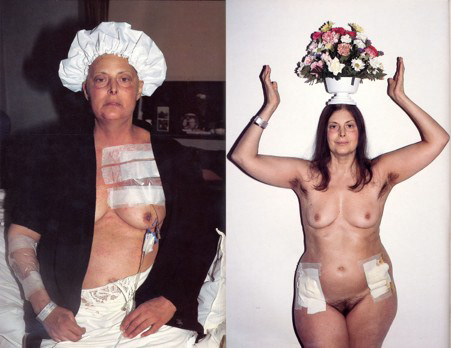
The photographs themselves are monumental in scale: large Chromogenic supergloss prints that confront the viewer with Wilke’s body at an imposing physical distance. Created during the three years leading up to Wilke’s death from lymphoma in 1993, Intra-Venus continues one of the central concerns of her practice: the body as both subject and material.
Intra-Venus Series No. 4, July 26 and February 19, 1992 is among the best-known diptychs in the series. In one photograph, Wilke is wrapped in a blue blanket; in the other, she raises her fingers to her face, touching and partially covering it. The image is striking for the way it recalls the gestures and visual language of her earlier work while being profoundly altered by the reality of her illness. Critics have also been drawn to this particular diptych, perhaps because of its readily recognizable art-historical references. Jacqueline Humphrey, who criticized Intra-Venus in 1996 for what she called its lack of “artistic basis,” nevertheless singled out this image, describing the photograph in which Wilke is wrapped in a hospital blanket as possessing “a touch of artful irony.”
Wilke’s body had always been central to her artistic practice. She used it as sculpture, monument, image, and material, repeatedly asking what it means to inhabit a female body within a culture shaped by objectification and patriarchal expectations. Intra-Venus continues these concerns, but it also moves beyond them. The work confronts something more frightening: the experience of illness and the terrifying uncertainty of approaching death.
During the first year of my research, my artwork has explored my physical connection to creation and the relationship between the body and material. I am interested in how this connection is reflected through form, placement, situation, embodiment, and experience. Developing this work has allowed me to gain a deeper understanding of what I am truly exploring and how these ideas manifest physically within my practice.
Wilke’s work is not only incredibly interesting to me, but also deeply moving. Intra-Venus presents a raw and intimate documentation of the body experiencing active disease. Wilke is just one example within a much wider history of representations of illness and disability in art. Artists such as Eva Hesse and Rebecca Horn have also negotiated their experiences as women artists alongside illness and physical conditions in very different ways. Why is this? Perhaps because there is no singular aesthetic that can define ill health. Illness does not necessarily need to carry negative connotations through its visual representation, nor does it have to conform to a particular visual language.
Within my own practice, organza has become a material through which I can explore these ideas. For me, it represents fluidity, movement, fragility, and the physical traces left on the body. Bruising is not directly depicted, but is instead suggested through specific colour choices that reference the different stages of healing. The material therefore becomes a way of communicating bodily experience indirectly, allowing vulnerability and physical change to exist through colour, transparency, movement, and form.
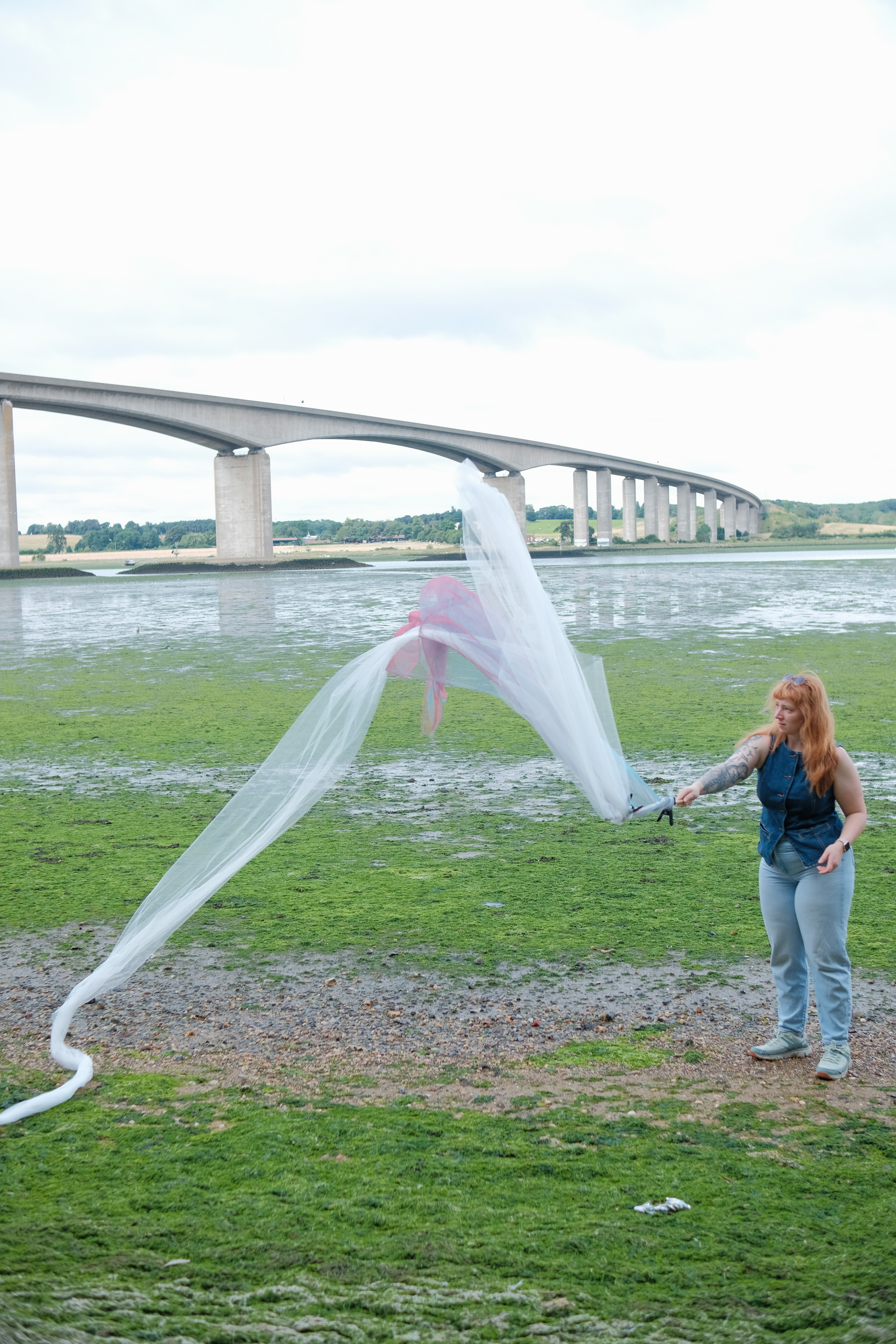
“I used to swim here”
Bobby Forsythe, 2026
Bobby Forsythe, 2026
I struggle with the idea that disability, flare-ups, and the other difficult aspects of living with health conditions do not necessarily have to be portrayed as entirely negative or “doom and gloom,” particularly when, for me, that is often how they feel. I find myself questioning whether, at this current stage of my practice, the use of airy fabrics, metallic materials, and UV light is becoming a way of aestheticizing pain. Perhaps I am transforming something that feels physically and emotionally difficult into something visually appealing. I am interested in this tension: whether aestheticising pain diminishes its reality, or whether it can instead provide another way of understanding, processing, and communicating an experience that is otherwise difficult to articulate.
Disability aesthetics asserts that beauty is not solely tied to harmony and integrity, but also encompasses the unique perspectives brought by disability. - Tobin Siebers (2005)