
Both concepts, Uncanny and Action, are very broadly defined within many different theoretical disciplines such as phenomenology, aesthetics, semiotics and epistemology, to name a few. The uncanny action as a possibility shall be explored. Using perspectives of philosophy and psychoanalysis. ‘’Psychoanalytic theory has had an incalculable influence on the modern movement in art, particularly where notions of the unconscious are concerned’’ (Harrison and Wood, 2003, p.378). The terms uncanny and action are not typically associated as a singular term. The uncanny is usually described as a singular theory that typically has a variety of different meanings depending on the theoretical aspect in which it is considered. The action is more of a physical approach, whereas the uncanny is more of an association to events, occurrences and situations. The concept of the uncanny action will be supported by examples of Marina Abramovic. Two pieces have been selected to specifically show evidence that the uncanny and the action can be a single theoretical term. To understand the term uncanny action the separate meanings of the terms uncanny and action must be first realised.
The uncanny is described by Sigmund Freud as belongs to the realm of frightening, of what evokes fear and dread (Freud, 2003, p.123) It shall be using Freud’s psychoanalytical viewpoint on the uncanny as a precedent to arguing the uncanny as an action. The principal meaning of the uncanny is the object of heterogenous interpretations (Cavallaro, 2007) in the classical senses of the feeling of the uncanny. Meaning that the uncanny is open to redefinition and that philosophy is a way of understanding orientation and for realising innovative ways of thinking. This will be done by using action to expand on the meaning of the uncanny. The uncanny being bought on by an action. This will be argued using relevant handpicked pieces of performance art, created by Marina Abramovic.
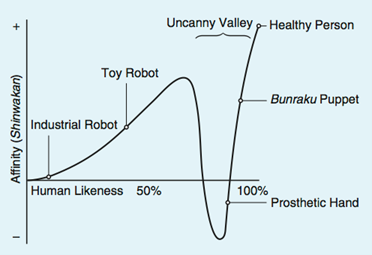
(The Uncanny Valley, Mori, 2012)
One example of the uncanny is Mashiro Mori’s theory. A roboticist created the term Uncanny Valley to describe the effect robots have on humans. The graph shows a record of humans reacting positively to robots that have realistic mechanisms. The steep decline represents the negative reaction to when a robot is too human-like but still lacks humanistic detail. This severe decline is known as the Uncanny Valley, the points where robots become creepy. It becomes a ‘porous’ divide between the real and the unreal (Trigg, 2012) The crossover of feeling uneasy over something which is recognizable and eerily close to realistic. However, this crossover doesn’t seem to always exist, not everything new and unfamiliar is frightening or uncanny (Freud, 2003) In order to recreate the familiar human form and actions, the properties of the human mannerisms and features can be reproduced and added to create artificial intelligence that will then become uncanny, this ‘’doesn’t necessarily have to become frightening, something must be added to the novel and the unfamiliar if it is to become uncanny’’ (Freud, 2003) One example of the Uncanny Valley is a robot created by Hanson Robotics that is named Sophia who is an automaton. Sophia can engage in a conversation and has an incredible human likeness (Hanson Robotics Ltd., n.d.) allowing her to change her facial expressions and even move. Her movement however is quite slow. This elaborates on the missing link that creates the Uncanny Valley. The realistic qualities that Sophia has and the materials she is made from are very human like to look at. But underneath the visible layer is a mechanical layer that operates and controls Sophia. This is where the uncertainty of accepting Sophia as a robot or as a human is created.
The uncanny that is referred to by Freud, also uses an example cited by Ernst Jentsch which refers to waxwork figures, ingeniously made dolls and automata. (Freud, 2003) Mike Kelley (American artist 1954-2012) is a contemporary artist who employed puppetry, animatronics and taxidermy to create an uncanny ambience exploring memory, recollection, horror and anxiety employing objects coupled with disturbing realistic, figurative sculptures to embody the feelings of uncanny. His work evokes fear and discontent but at the same time is strangely familiar. This gives credence to the idea that the uncanny is nothing else than a hidden, familiar thing that has undergone repression and then emerged from it. (Tate, 2018) To further broaden the uncanny within art, Polly Morgan (Born in ofxfordshire1980 Taxidermist) (Pollymorgan.co.uk, n.d.) is an example of contemporary taxidermy practice. A technique of preserving dead animals and displaying them. The reasoning for taxidermy being uncanny is the direct confrontation of death. Some taxidermists dress up the preserved animals as well, creating dioramas. This creates the connotation of feeling unnerved by the nature of the piece of work.
Danto (1924-2013 was an American art critic and philosopher) first introduced the need for action as term. He started with a basic action being caused by an ‘agent’ that isn’t influenced by anything else. A fitting analogy being an agent (in this case a person) pulling a trigger without another factor occurring first. Such as his finger being pulled by something else, thereby causing the trigger to be pulled. (J. Moya, 1990) This basic action is a direct action. ‘’Basic actions, then, are designed to stop the infinite regress and to allow for the existence of any other action’’ (J. Moya, 1990) Carlos J. Moya who wrote a piece called, The Philosophy of Action 1990, refers to the action as a series of casually related happenings (J. Moya, 1990) To expand this quote for a better understanding, Moya used a very effective example to explain the difference between an action and a happening. Moya started off using a gun as the object within this example. In one circumstance, the gun has been aimed at a target and the trigger is pulled, the gun fires (J. Moya, 1990) In a contrasting scenario, a person arrives home and puts the gun on the table, once the gun is in transition to being put down, it unexpectedly fires. (J. Moya, 1990) Moya explains that the first example is a representation of an action, this is because the gun was being used as an object purposefully. Whereas in the second example it represents a happening because the gun was fired accidentally. An action can be argued to be infinite in nature in that its cause generates subsequent actions, each action having a result otherwise termed as happening. Actions could therefore be ‘’characteristic sequences of happenings’’ (J. Moya, 1990) Functionalism believes that mental states should not be identified with fixed physical properties but rather studied in terms of the functions that link a physical experience with mental state. (Cavallaro, 2007) This quote describes my reasons for choosing Marina Abramovic’s work. To discuss that the uncanny action is a real descript term.
Marina Abramovic, a performance artist is known for her method of performing through testing and overcoming her own limits in extenuating duel between the mind and the body. (Abramović, Sileo and Viola, 2012) Abramovic does this in an effective way of potentially putting her life at risk through a series of performance pieces. She does this by breaking patterns and going against conventions, digging deep into her own fears and into those of her viewers. (Abramović, Sileo and Viola, 2012, p.88) Abramovic in her performance becomes the nucleus (Freud, 2003) This means that her role acts as the most important part within her work. In scientific terms the nucleus (Freud, 2003) controls the cells and all living organisms. In this circumstance her audience become the cells. Without Abramovic’s use of the audience and narrative, her aim of wanting to communicate through action wouldn’t be as effective as it is. That is why suggesting Abramovic previously as a nucleus is acceptable. It also highlights the strong influence Abramovic has and can create through her use of performance. ‘’Isn’t the pure art experience in movement, sound or paint, the ultimate truth that is lost when we try to communicate it in another language?’’ (Mcniff, 2010, p.35) This emphasises that if Abramovic were to simply have painted her performance pieces, they wouldn’t have the same uncanny impact that is realised by the onlooker experiencing the act of her message. Abramovic has moved her studio space metaphysically into a public space, her installations effectively become her canvas. (Schwab, 2013)
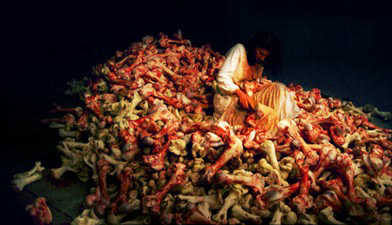
(Balkan Baroque I, 1997, n.d.)
One example of Abramovic’s work is Balkan Baroque this was a piece performed in the Venice Bienalle in 1997 and lasted for six hours a day over four consecutive days. This piece involved Abramovic sitting on top of a mound of clean bones on to which a further 1,500 fresh bones were sat. These fresh bones were covered with bloody flesh that she obsessively cleaned with a brush and bucket of water. (Abramović, Sileo and Viola, 2012) Throughout the four days of cleaning these bones, Abramovic cried and sung folk songs from each of the Yugoslav Republics for extended periods of time. (Abramović, Sileo and Viola, 2012)
The bones evidence the relationship in this piece to the uncanny. ‘’The acme of the uncanny is represented by anything to do with death and dead bodies’’ (Freud, 2003) Abramovic’s use of cleaning the bones can also relate to the idea the reason that the action is so uncomfortable is that the action includes elements that relate so closely to the human anatomy. This creates the unnerving feeling of death and horror. Abramovic, accompanying the action with singing and crying adds to the performance and creates an eerie atmosphere. It is by this action the uncanny is present.
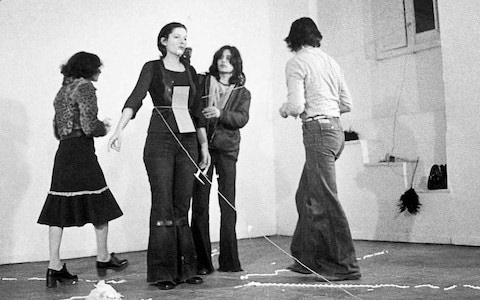
(Rhythm 0, 1974, Telegraph, 2017)
Another example of Marina Abramovic’s work is Rhythm 0, a performance piece conducted in studio Morra, Naples in 1975. This piece lasted for six hours and the aim of the piece for Abramovic was designed to see how far she could be physically vulnerable and how far the public would go and do things to her body. (Abramović, Sileo and Viola, 2012) The only rules set to the audience were the instructions given by her that ‘There are seventy-two objects on the table that one can use on me as desired.’ (Abramović, Sileo and Viola, 2012) Giving the decision to the audience that then becomes their responsibility on how they contribute to the performance. Abramovic chose the objects specifically, having objects to resemble pleasurable experience, such as: flowers, feathers and a rose. The other objects were chosen as objects of pain. These included a diverse array of objects: knives, a whip, chains and even a gun with one bullet. Abramovic pushed her limits of resistance with this piece and almost lost control of her life to try and understand how vulnerable she could be. If the rules laid out by Abramovic were more extensive it would have limited the audience’s freedom. Then the situation would be different. If this piece was performed in a different setting for example, in a classroom with a student being used in place of the artist with a variety of objects. The setting would have required the need for more restrictions on the rules and there would have been consequential repercussions. The freedom given allowed the audience, once comfortable and well-situated to violate Abramovic as they pleased.
In Abramovic’s piece, Rhythm 0, the action described by Danto and Moya is very evident here. To consider Abramovic as the main initiator for everything that happened through-out the piece is acceptable because of the lack of ruling stated. The rules that were given acted as a catalyst for the next series of events that occurred within the piece. Danto’s explanation of an agent discussed earlier within this text describes the audience all as individual agents. Referring to the audience as individual agents each carrying out certain actions with the use of props given. What each agent chose to do with the objects and how they used the objects will result in the happening. An example would be that one of the agents picked up the knife and cut Abramovic’s neck and blood was drawn. (Abramović, Sileo and Viola, 2012) The cutting of the neck that leads to the reveal of blood is known here as a happening. Meaning each action having a result will be known as a happening. (J. Moya, 1990) The lifting of the knife via the agent’s hand was the basic action. Another viewpoint will to be to look at the action as a desire. An action may be caused without the agent being caused to perform it (Davidson, 2006) Donald Davidson discusses the term desire and how it influences action. The way the desire links with Rhythm 0 is through the willingness shown by the audience taking part. The desire is initiated by the action of the first agent to pick up an object to then interact with Abramovic. The second agent’s desire wasn’t their own it was a direct result of the first agent’s actions. Desire was the cause of his doing it (Davidson, 2006) The desire became even more uncanny in the sense Abramovic was fearful and filled with dread that her life was in danger (Abramović, Sileo and Viola, 2012) and the agent’s desire became a morbid desire, deriving pleasure from the possibility of causing pain.
The aim of this essay was to determine whether the uncanny action truly exists, in terms that can be explained theoretically. This has been done by exploring the meanings of the uncanny and action respectively by citing examples from written theories and by considering two pieces of work by a performance artist, Marina Abramovic. Considering how the uncanny can have an impact on action and vice versa. This has been explored within this essay. The uncanny isn’t usually linked definitively in relation to an action as realised through the research of the action theory of Moya and Danto. The uncanny however is built up of the theory of inanimate and life (Freud, 2003), constantly going back and forth with the idea that the uncanny can create an almost realistic experience as referenced in the Uncanny Valley and examples of artistry executed using familiarity using a combination of realism and man crafted objects and scenarios. To create artwork that is often emotionally disturbing. This has been briefly explained within the selection of examples attributed to the uncanny by various theoretical disciplines such as Sofia and artists: Mike Kelley and Polly Morgan. Exploring the uncanny action by focusing on specific examples of work to address and thereby realise the link between the uncanny and action. Utilising a performance artist such as Marina Abramovic first to explore the terms uncanny and action as separate theories was useful in establishing this link. Because both terms are very broad in terms of theory and it is not inconceivable to accept that the two can cross over and form a singular theory. The idea that the uncanny can create a sense of familiarity through experiencing a certain scenario, like the situations in Abramovic’s performance pieces, whether it be the intention of the piece or not has been realised. Even though Abramovic doesn’t definitively link herself to the uncanny, her works can certainly be described as uncanny. Balkan Baroque, the more graphic of both pieces of art was a suitable piece of work to reference the uncanny as it has elements of horror and produces fear. Which Freud described in his written essays, The Uncanny. Action from a philosophical standpoint was a very broad area to initially start researching as there were too many challenging assumptions that could’ve been made. To connect the uncanny action through the example of Abramovic’s, Rhythm 0. seemed very challenging as assumptions cannot be made with how the audience were feeling before acting. It became clearer when the realisation of the happenings, explained in Moya’s piece, The Philosophy of Action, was simply the outcome of the audience being individual agents. It also raises the question if the action, events and happenings would have taken place in contrasting scenarios in different settings. Such as the example used of the classroom as one setting is more formal than the other. Abramovic was the catalyst for the uncanny in both pieces explored. Both pieces produced elements of fear, dread, death, familiarity and repetition all of which are definitions of the uncanny. All actions that occurred in the pieces were the result of or influenced by an element of the uncanny. But the opposing argument could be the action influences the uncanny. The balance of which are both subject to alter depending on the situation or setting. The uncanny action can be concluded to have a place in the theory of critical thinking. By analysing critically just two examples of performance art this has been realised successfully, using theories already accepted by critical thinkers to be a plausible concept.
References
Abramović, M., Sileo, D. and Viola, E. (2012). Italian works. [Milano: 24 ORE Cultura], pp.88, 128.
Balkan Baroque I, 1997. (n.d.). [image] Available at: http://www.lissongallery.com/artists/marina-abramovic/gallery/882 [Accessed 13 Jan. 2018].
Cavallaro, D. (2007). Critical and cultural theory. London [u.a.]: Athlone Press, p.IX, 147.
Davidson, D. (2006). The philosophical essays of Donald Davidson. Charlottesville, Va.: InteLex Corporation, p.65.
Freud, S. (2003). The uncanny. London: Penguin Books, pp.123-125.
Hanson Robotics Ltd. (n.d.). Sophia - Hanson Robotics Ltd.. [online] Available at: http://www.hansonrobotics.com/robot/sophia/ [Accessed 11 Jan. 2018].
Harrison, C. and Wood, P. (2003). Art in theory, 1900-2000. Malden, MA: Blackwell, p.378.
IEEE Spectrum: Technology, Engineering, and Science News. (2012). An Uncanny Mind: Masahiro Mori on the Uncanny Valley and Beyond. [online] Available at: https://spectrum.ieee.org/automaton/robotics/humanoids/an-uncanny-mind-masahiro-mori-on-the-uncanny-valley [Accessed 10 Jan. 2018].
J. Moya, C. (1990). The Philosophy of Action: An Introduction. pp.3-13.
McNiff, S. (2010). Art-based research. London [u.a.]: Jessica Kingsley, p.35.
Mori, M. (2012). Uncanny Valley. [image] Available at: https://spectrum.ieee.org/img/Figure%201%20Uncanny%20Valley-1338912955829.png [Accessed 10 Jan. 2018].
Pollymorgan.co.uk. (n.d.). Biography – Polly Morgan. [online] Available at: http://pollymorgan.co.uk/biography/ [Accessed 12 Jan. 2018].
Schwab, M. (2013). Experimental systems. p.126.
Tate. (2018). Mike Kelley: The Uncanny – Exhibition at Tate Liverpool | Tate. [online] Available at: http://www.tate.org.uk/whats-on/tate-liverpool/exhibition/mike-kelley-uncanny [Accessed 9 Jan. 2018].
Telegraph (2017). Rhythm 0. [image] Available at: http://www.telegraph.co.uk/art/artists/shocking-controversial-pieces-modern-art/rhythm-0-1974-marina-abramovic/ [Accessed 19 Oct. 2017].
Trigg, D. (2012). The memory of place. Athens, OH: Ohio University Press, p.31.